
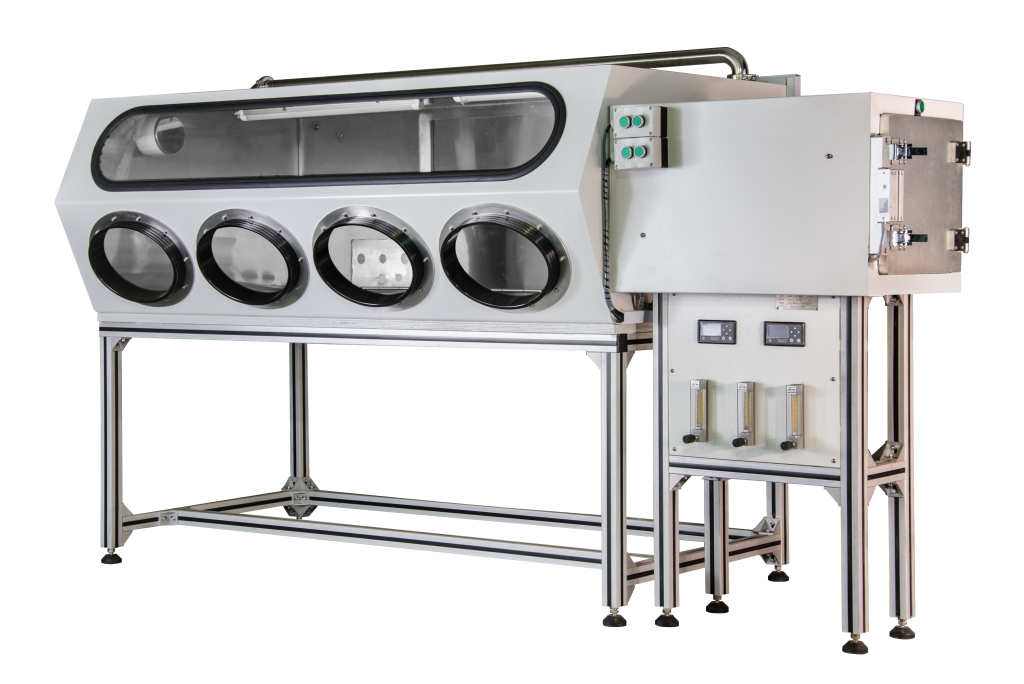
In lithium-ion battery R&D laboratories, the entire preparation process of pouch cells is highly sensitive to moisture and oxygen contamination. The traditional “multi-equipment cross-environment transfer” model easily introduces impurities and undermines experimental reproducibility. This article focuses on the solution of integrating a small coating machine, manual slicer, stacking fixture, and electrolyte injector in a vacuum glove box, elaborating on a fully continuous process from electrode coating to semi-finished pouch cell packaging within a single inert environment. It provides an efficient, contamination-free small-batch preparation reference for researchers.
1. Core Configuration and Environmental Standards of the Integrated System
The entire process is integrated into a vacuum inert gas glove box (H₂O and O₂ content <1 ppm, dew point ≤-45°C), with core equipment adapted for in-chamber installation and operation, eliminating cross-chamber transfer risks.
- Small Coating Machine: Slot-die/doctor-blade type, compatible with aluminum foil (cathode) and copper foil (anode) current collectors, supporting micron-level uniform coating and in-situ drying;
- Manual Slicer: High-precision die-cutting with customized molds for cutting cathode/anode electrodes and separators, with dimensional tolerance ±0.1 mm;
- Stacking Fixture: Positioning anti-misalignment design, suitable for laboratory-scale small-format cells, ensuring aligned alternating stacking of cathode/anode electrodes and separators;
- Precision Electrolyte Injector: Inert environment-specific, controllable injection volume (accuracy ±0.5%), equipped with a vacuum-assisted infiltration module;
- Vacuum Sealer: Dedicated for pouch aluminum-laminated film, supporting pre-sealing and final sealing with vacuum degree ≤-0.09 MPa, preventing air entrapment.
2. Step-by-Step Analysis of the Continuous Process Inside the Glove Box
2.1 Electrode Coating and In-Situ Drying (Completed In-Chamber)
Load cathode (e.g., NCM, LFP) and anode (graphite, silicon-carbon) slurries into the small coating machine’s feed hopper. Under the glove box’s inert atmosphere, uniformly coat the slurries onto aluminum/copper foil surfaces (single-sided coating density: 20–40 mg/cm²). After coating, activate the equipment’s integrated low-temperature drying module (60–80°C) to evaporate solvents in-situ, avoiding moisture adsorption when electrodes are moved out of the chamber. The water content of dried electrodes is <50 ppm.
2.2 Precision Slicing (Contamination-Free Transfer)
Directly transfer dried electrodes to the manual slicer inside the chamber. Install customized molds according to experimentally designed dimensions (e.g., cathode: 12 mm, anode: 14 mm, separator: 16 mm) to complete one-time die-cutting of cathode/anode electrodes and separators. The slicing process is fully sealed with no air contact, ensuring clean electrode surfaces free of dust and moisture residues.
2.3 Precision Stacking (Short-Circuit Prevention, High Alignment)
Transfer cut cathode/anode electrodes and separators to the stacking fixture. Stack them alternately in the sequence “anode → separator → cathode → separator”. The fixture’s positioning grooves ensure interlayer alignment (misalignment <0.2 mm), preventing short circuits from edge contact. After stacking, place the cell into a preformed aluminum-laminated film bag, complete three-side pre-sealing, and reserve an injection port.
2.4 Inert Environment Electrolyte Injection (Precise Dosing, Full Infiltration)
Activate the precision electrolyte injector. Under the glove box’s high-purity argon atmosphere, inject a quantified electrolyte (e.g., 1.0 M LiPF₆ EC/DEC system) into the cell through the reserved port. After injection, activate the vacuum-assisted module (vacuum degree ≤-0.09 MPa) and let it stand for 10–15 minutes to accelerate electrolyte infiltration into electrodes and separators, eliminate bubbles, and improve ion conduction efficiency.
2.5 Vacuum Final Sealing (Fully Sealed, Leak and Contamination Prevention)
After electrolyte infiltration, transfer the cell to the vacuum sealer and complete vacuum heat sealing of the last side under an inert environment (temperature: 185°C, time: 5 s). Inspect sealing integrity to ensure no leakage or air ingress, yielding a semi-finished pouch cell ready for subsequent formation and testing directly inside the chamber.
3. Core Advantages of the Integrated Process (Adapted for Laboratory R&D Scenarios)
- Full-Process Contamination-Free: The entire workflow from coating to sealing is completed within a single glove box, eliminating moisture/oxygen/dust contamination and significantly improving experimental reproducibility and data reliability;
- High Efficiency and Time Savings: Intermediate steps such as electrode transfer, secondary drying, and environmental adaptation are eliminated, reducing the preparation cycle for a single batch (5–10 cells) by over 30%;
- Flexible Adaptability: The compact equipment combination meets laboratory small-batch, multi-formulation R&D needs, enabling rapid iterative testing of cathode/anode materials and electrolyte systems;
- Cost-Effective: Avoids procurement costs for multiple independent devices and maintenance costs for multiple environments, simplifying operation and maintenance with a single inert glove box environment.
4. Research Applications and Practical Recommendations
This integrated process is particularly suitable for laboratory scenarios such as novel electrode material validation, electrolyte formulation screening, and pouch cell mechanism research, enabling precise control of process parameters and exclusion of environmental interference factors. Practical recommendations: ① Maintain glove box H₂O/O₂ indicators stably at <1 ppm and regularly inspect the purification system; ② Customize coating and slicing molds as needed to ensure electrode consistency; ③ Accurately calculate injection volume based on cell capacity to avoid performance impacts from over/under-dosing.
Conclusion
The integrated coating-slicing-stacking-electrolyte injection-sealing process in a vacuum glove box breaks the environmental barriers of traditional pouch cell preparation, providing a “one-stop, contamination-free, high-efficiency” solution for laboratory research. Adaptable to all moisture/oxygen-sensitive batteries (e.g., solid-state batteries, lithium metal batteries), this solution empowers researchers to accelerate material iteration and process optimization, advancing the R&D of high-performance pouch cells.