
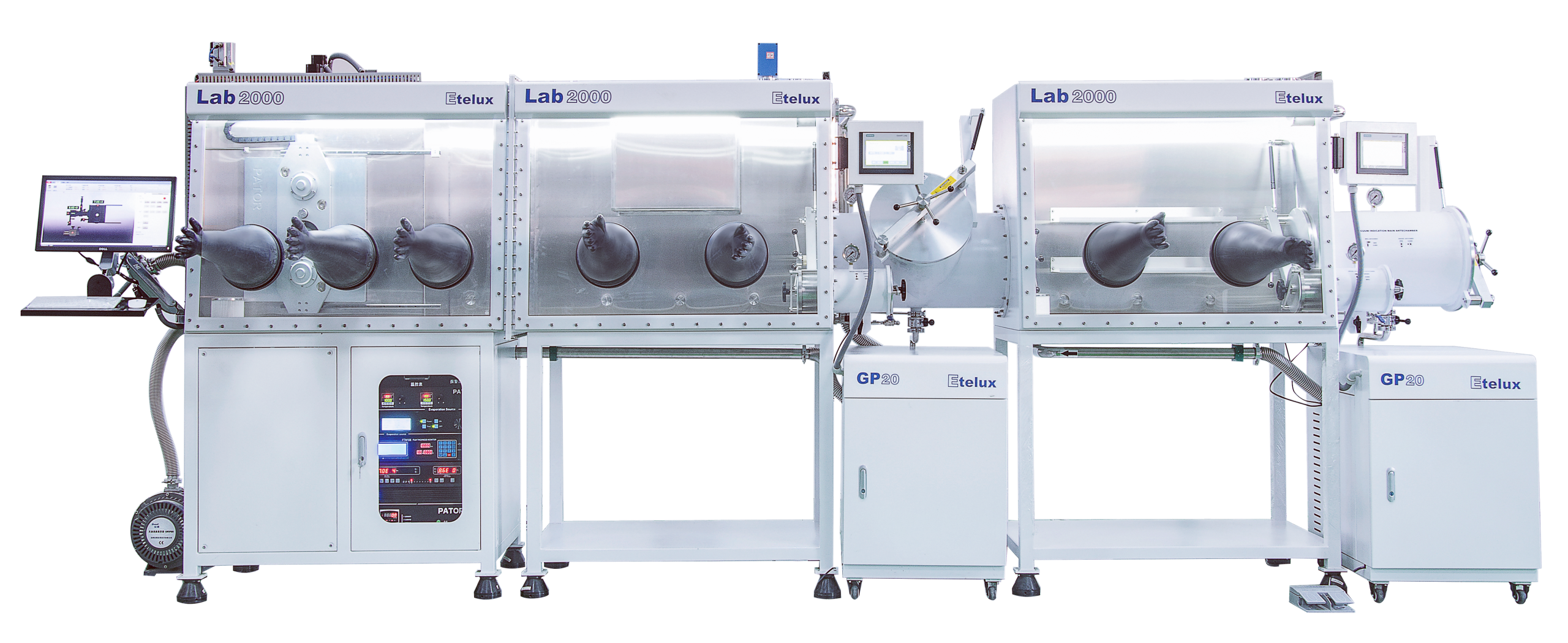
1. Introduction: Why Does Vacuum Coating Need a Dedicated Glovebox?
1.1 The Symbiotic Relationship Between Vacuum Coating and Gloveboxes
In vacuum coating processes, thin-film quality is not solely determined by the coating equipment itself, but also relies heavily on strict environmental control throughout the entire workflow, covering sample preparation, thin-film deposition, and post-treatment procedures.
Highly moisture and oxygen-sensitive materials, including perovskite solar cell materials, OLED functional devices, and lithium metal anodes, will suffer irreversible performance degradation even with tens of seconds of exposure to ambient air. Traditional vacuum coaters can only provide a high-vacuum environment during the deposition stage, yet fail to isolate air contamination during critical links such as substrate loading, sample transfer, and pre-treatment processing.
The core advantage of integrating a professional glovebox with a vacuum coating system is to realize full-process inert atmosphere protection for substrate preparation, sample transfer, thin-film deposition and even device encapsulation, completely eliminating air exposure risks. This integrated solution significantly reduces process contamination and effectively preserves the intrinsic physical and chemical properties of sensitive functional materials.
1.2 The Cost of Poor Selection
Improper glovebox selection will lead to dual technical and economic losses for vacuum coating production and R&D:
Technical losses: Excess moisture and oxygen in the working environment will cause thin-film oxidation, interface performance attenuation, and final device failure. Long-term and repeated process debugging results may be completely invalid due to unqualified glovebox environmental control performance.
Economic losses: Mismatched equipment will trigger frequent rework, forced production shutdowns, and even repeated equipment procurement. A hidden long-term cost cannot be ignored: blindly pursuing low upfront procurement costs will lead to increased inert gas consumption, more frequent purification column regeneration, and higher daily maintenance expenses throughout the equipment lifecycle.
1.3 Who This Guide Is For
Process and R&D Engineers: Obtain clear and actionable technical parameter standards and process matching logic to guide equipment selection and process optimization.
Procurement and Decision-Makers: Master systematic supplier evaluation frameworks and full lifecycle Total Cost of Ownership (TCO) calculation methods to support scientific procurement decisions.
This guide adopts a progressive and logical selection logic: clarify process requirements → confirm core technical parameters → determine equipment configuration → screen and evaluate suppliers.
2. Step 1: Define Your Coating Process First – Process Matching Is the Starting Point
2.1 Different Coating Processes Have Different Requirements
The primary premise of glovebox selection is to clarify the special environmental and structural requirements of the target vacuum coating process, and match targeted equipment configurations.
| Coating Process | Key Special Requirements for Glovebox |
|---|---|
| Thermal Evaporation | Equipped with thermal radiation shielding structure and supporting cooling system integration interface |
| Electron‑Beam Evaporation | Configure professional E-beam shielding devices and standardized high-voltage penetration interfaces |
| Magnetron Sputtering | High structural rigidity and precise vibration damping design (sputtering targets and thin-film formation are extremely sensitive to mechanical vibration) |
| OLED/Perovskite Deposition | Ultra-low water and oxygen control (<0.1 ppm), equipped with independent organic solvent adsorption and recovery system |
The configuration logic of integrated glovebox-coating systems varies significantly by process. For instance, magnetron sputtering systems prioritize structural stability and vibration suppression, while OLED and perovskite deposition systems focus on extreme inert environment control and solvent pollution prevention.
2.2 Clarifying Glovebox Types – Vacuum vs. Purification
The distinction between vacuum gloveboxes and purification gloveboxes is the most confusing core link in selection, as the two adopt completely different working principles and application scenarios:
Vacuum Glovebox: The core working principle is vacuum pumping + inert gas backfilling replacement, suitable for vacuum transfer and short-term vacuum operation scenarios. Its inherent defect is the lack of continuous environmental purification capacity; after a single pump-fill cycle, the internal water and oxygen content will gradually rise and cannot be maintained stably for a long time.
Purification Glovebox: The core advantage is long-term stable maintenance of ultra-low water and oxygen environment. It is equipped with a built-in circulating purification system (molecular sieves for water adsorption, copper catalyst for oxygen removal), which can continuously purify the internal gas and maintain high-purity inert atmosphere for a long time.
Critical Reminder: Vacuum gloveboxes cannot replace purification gloveboxes due to the absence of circulating regeneration purification function. Meanwhile, standard purification gloveboxes are designed for positive pressure operation and cannot be evacuated, as they cannot withstand long-term vacuum environment and are prone to sealing failure and structural damage.
For vacuum coating integrated application scenarios, the standard matching equipment is a vacuum-compatible purification glovebox. It not only supports vacuum pumping for load lock and coating system docking, but also maintains long-term stable ultra-low water and oxygen environment for sample processing and storage.
2.3 Selection Decision Tree
Follow the following progressive logic to determine the optimal glovebox configuration:
- Material moisture/oxygen sensitivity level → Determine the core index of water and oxygen control accuracy (<0.1 ppm / <1 ppm / <10 ppm / <100 ppm)
- Equipment operation frequency (daily door opening times, continuous working hours) → Match single-column/dual-column purification system and automatic regeneration configuration
- Sample size and batch processing volume → Confirm glovebox chamber volume and load lock dimensional specifications
- Vacuum coating process type → Configure special functional modules such as vibration isolation, heat shielding, and solvent traps
3. Step 2: Deep Dive into Core Technical Parameters
3.1 H₂O/O₂ Specification – The Primary Hard Performance Indicator
The water and oxygen specification refers to the real-time concentration of moisture and oxygen inside the glovebox (unit: ppm, 1 ppm = 0.0001%), which is the most intuitive index to measure the inert atmosphere level.
Performance Grading and Applicable Scenarios
| Grade | Specification | Typical Applications |
|---|---|---|
| Ultra-low | <0.1 ppm | OLED functional materials, perovskite solar cells, quantum dot devices, superconducting material research |
| High-purity | <1 ppm | Lithium metal materials, high-nickel cathode materials, high-sensitivity catalytic materials |
| Demanding | <10 ppm | Solid electrolyte materials, MOF materials, silicon-based anode materials |
| Moderate | <100 ppm | Conventional lithium-ion battery positive/negative materials, organic synthesis, metal powder processing |
| Basic | ≥1000 ppm | General anti-oxidation and moisture-proof operation, pharmaceutical dispensing, university teaching and demonstration |
Selection Advice: Excessively high specifications do not equate to optimal cost performance. For conventional processes that stably operate at 50 ppm, blindly pursuing <1 ppm ultra-low indexes will only increase unnecessary equipment procurement and maintenance costs. However, for high-precision vacuum coating scenarios such as OLED and perovskite devices, <1 ppm is the mandatory basic specification.
Key Note: The instantaneous index after equipment startup is not equal to long-term stable performance. Many devices can reach <1 ppm in a static state after startup, but the water and oxygen concentration rises rapidly after multiple door opening and closing operations. The core evaluation standard is long-term dynamic stability, which depends on equipment leak rate and purification system efficiency.
3.2 Leak Rate – The Core Guarantee of Long-Term Stability
Leak rate is the most critical sealing performance parameter of the glovebox, directly determining whether the internal ultra-low water and oxygen environment can be stably maintained for a long time, and is the fundamental index to distinguish high-quality equipment from ordinary equipment.
Industry Standard Grade Comparison
| Leak Rate Grade | Typical Value | Applicable Scenarios |
|---|---|---|
| Premium Grade 1 | <0.001 vol%/h | High-end OLED/perovskite vacuum coating, top-tier scientific research and precision preparation |
| Industry Standard Grade | ≤0.05 vol%/h | Conventional vacuum coating industrial production and general R&D experiments |
Test Standard Specification: The test is implemented in accordance with ISO 10648‑2:1994 / EJ/T 1096‑1999 Containment enclosures – Part 2: Classification of leak tightness and associated checking methods. The oxygen tracer method or pressure decay method is adopted, with the test pressure controlled between -2.5 ~ -10 mbar and all glove ports fully sealed during the test.
Procurement Tip: Require suppliers to provide third-party professional test reports conforming to ISO 10648‑2 standard, instead of only relying on suppliers’ internal self-test data.
3.3 Chamber Material and Structural Design
304 Stainless Steel (thickness ≥3 mm): The preferred material for vacuum coating matched gloveboxes. It features excellent corrosion resistance, high structural strength, and reliable overall sealing performance. The brushed inner surface further optimizes corrosion resistance and internal cleaning convenience, adapting to long-term high-precision inert environment operation.
Front Observation Window: Adopt 8 mm thick tempered safety glass, matched with flange-type O-ring vacuum sealing structure, to ensure long-term zero-leakage sealing performance. High-end models are equipped with double-layer integrated vacuum sealing structure for enhanced stability.
Material Warning: Acrylic/PMMA materials have good light transmittance but high gas permeability, which cannot meet the long-term stable ultra-low water and oxygen environment requirements of vacuum coating. It is only applicable to low-demand basic anti-oxidation scenarios and strictly prohibited for high-precision coating processes.
3.4 Vacuum Performance and System Integration Capability
Chamber Vacuum Degree: The ultimate vacuum and working vacuum of the glovebox must be fully matched with the supporting coating equipment. For thermal evaporation processes, the stable working vacuum requirement is lower than 8×10⁻⁴ Pa.
Load Lock/Transfer Chamber: The mainstream standard size is Φ360×600 mm, equipped with double-door interlock protection structure to avoid air cross-contamination. The built-in sliding sample tray simplifies the automatic transfer of samples between the glovebox and the coating chamber.
Interface and Penetration Ports: KF40 flange is the standard universal interface. The rear panel of the glovebox is reserved with special flanges for seamless docking with coating equipment. At least 3 spare vacuum flanges are reserved for subsequent equipment upgrading and functional expansion.
3.5 Purification Circulation System
The core of the purification system is composed of molecular sieve water removal modules and copper catalyst oxygen removal modules. The internal gas circulates continuously through the purification columns: molecular sieves adsorb residual moisture in the gas, and the treated dry gas reacts with the copper catalyst to remove residual oxygen, realizing real-time purification of the internal atmosphere.
Single/Dual Purification Column Configuration: Single-column configuration meets the demand of low-frequency intermittent operation; dual-column configuration supports alternate regeneration and continuous operation, which is the optimal choice for long-term uninterrupted vacuum coating production.
Circulation Blower: It is recommended to select a blower with a flow rate ≥90 m³/h, and the variable frequency drive (VFD) configuration can realize intelligent adjustment of circulation speed according to environmental changes, reducing energy consumption.
Automatic Regeneration System: Adopt PLC intelligent automatic control. The regeneration gas is a mixed working gas containing 5%-10% hydrogen. When the purification column is saturated, the system automatically completes vacuum pumping, heating activation, and gas purging to restore the water and oxygen removal capacity of molecular sieves and copper catalysts, without manual intervention.
3.6 Control System and Real-Time Monitoring
PLC Touch Control System: Real-time display of core data such as internal water/oxygen content, air pressure, and system operating status. It integrates functions of precise pressure regulation, automatic gas replacement, abnormal alarm, fault prompt, and manual/automatic dual-mode leak detection.
High-Precision Analyzer: The standard measurement range is 0-1000 ppm (oxygen) and 0-500 ppm (moisture), with a measurement accuracy ≥0.2 ppm. The analyzer is directly connected to the PLC control terminal to realize automatic linkage adjustment of the circulation purification system.
Pressure Control: The internal working pressure can be adjusted freely within the set range. Equipped with foot switch control, it facilitates convenient pressure adjustment operation during sample handling.
4. Step 3: Procurement Decision-Making Framework
4.1 Technical Evaluation – 10 Mandatory Inspection Items
Procurement and technical teams can score and screen suppliers through the following quantitative evaluation checklist to ensure equipment performance matches process requirements:
| No. | Evaluation Item | Weight Level | Scoring & Acceptance Criteria |
|---|---|---|---|
| 1 | Water/oxygen index compliance | ★★★★★ | Provide real test data and valid third-party detection reports to meet process precision requirements |
| 2 | Leak rate and test standard | ★★★★★ | Meet premium grade (<0.001 vol%/h) or industry standard (≤0.05 vol%/h), tested in accordance with ISO 10648‑2 |
| 3 | Chamber material and thickness | ★★★★ | Adopt 304 stainless steel with wall thickness ≥3 mm, with complete material certification |
| 4 | Load lock size and operability | ★★★★ | Size matches sample batch processing requirements, equipped with sliding transfer tray and double-door interlock |
| 5 | Purification system configuration | ★★★★ | Single/dual column and regeneration mode match daily operation frequency and continuous production demand |
| 6 | Control system accuracy | ★★★ | Adopt mainstream brand PLC controller, analyzer accuracy ≥0.2 ppm, stable data display |
| 7 | Coating machine integration solution | ★★★★★ | Reserved matching flanges, compatible communication protocols, and seamless linkage control |
| 8 | Equipment expandability | ★★★ | Modular design, reserved spare interfaces, supporting subsequent functional upgrading and transformation |
| 9 | Supplier qualification and technical support | ★★★★ | Have mature industry application cases, capable of providing targeted process matching suggestions |
| 10 | Warranty and after-sales service | ★★★ | Clear warranty period, fast after-sales response, and complete spare parts supply system |
4.2 Commercial Evaluation – Full Lifecycle Total Cost of Ownership (TCO)
Procurement decisions cannot be based solely on the initial purchase price. It is necessary to comprehensively calculate the full lifecycle TCO of the equipment to avoid hidden long-term costs:
Initial Procurement Cost: Equipment body price + installation and commissioning fee + technical training fee
Daily Operating Cost: Inert gas consumption (low leak rate can effectively reduce gas loss) + purification column regeneration and replacement cost + energy consumption of blower and vacuum pump
Regular Maintenance Cost: Sealing ring replacement, sensor calibration, vacuum pump maintenance and overhaul
Hidden Opportunity Cost: Production shutdown and yield loss caused by equipment failure and performance attenuation
Core Procurement Principle: Never sacrifice core performances such as leak rate, water/oxygen control accuracy and chamber structural strength for low upfront prices. The long-term maintenance, rework and yield loss costs of low-cost inferior equipment far exceed the initial price difference. The optimal solution should be matched according to the actual operation frequency and process precision requirements.
4.3 Domestic vs. Imported Equipment – Pragmatic Performance and Cost Trade-off
| Evaluation Dimension | Domestic Equipment | Imported Equipment |
|---|---|---|
| Core Technical Specifications | Can reach industry-leading indexes of <0.001 vol%/h leak rate and <1 ppm water/oxygen | Slightly better long-term ultra-low index stability in extreme environments |
| Procurement Price | Significantly lower, high cost performance | High overall cost, expensive spare parts |
| After-sales Service | Fast on-site response, short maintenance cycle | Slow service response, long spare parts delivery cycle |
| Customization Capability | Flexible configuration, supporting personalized process customization | Mostly standardized products, low customization flexibility |
Practical Selection Suggestion: On the premise that all technical indexes fully meet process requirements, prioritize suppliers with the fastest after-sales response and on-site service capability, and balance budget and long-term operating costs.
5. Step 4: From Selection to Acceptance – Standardized Implementation Workflow
5.1 Clear Demand Definition
Fill in the standardized Vacuum Coating Glovebox Process Requirement Checklist, covering core information such as coating process type, material sensitivity grade, target water/oxygen index, sample size and daily operation frequency. Meanwhile, clarify on-site installation conditions including cleanroom grade, placement space, and supporting utilities (power supply, inert gas supply).
5.2 Technical Communication and Bid Evaluation
Require suppliers to provide complete technical proposal documents, including process flow diagrams (P&ID) and equipment overall layout drawings. Priority can be given to visiting suppliers’ existing mature supporting projects on-site to verify actual equipment operation effect. In advance, request the template of third-party test reports to clarify unified acceptance standards.
5.3 Installation, Commissioning and Standard Acceptance
Leak Rate Test: Implement detection in strict accordance with ISO 10648‑2 standard, adopt oxygen tracer method or pressure decay method; high-precision scenarios can use helium mass spectrometry detection (detection limit 5×10⁻⁸ Pa·m³/s).
Water/Oxygen Performance Test: Use 99.999% high-purity inert gas for empty chamber commissioning, and the stable water and oxygen concentration after system operation shall be lower than 1 ppm.
Vacuum Performance Test: Verify that the equipment ultimate vacuum and pumping speed meet the design specifications. For thermal evaporation processes, the ultimate vacuum is required to be better than 2.5×10⁻⁵ Pa, and the stable working vacuum is better than 8×10⁻⁴ Pa.
System Integration Test: Verify the communication linkage, interlock protection and synchronous operation function between the glovebox and the coating equipment to ensure smooth sample transfer and coordinated operation.
5.4 On-Site Training and Document Handover
Complete professional operation and emergency disposal training for on-site operators. Require suppliers to hand over complete technical documents, including equipment maintenance manuals, spare parts list, warranty certificates and test reports.
6. Common Selection Pitfalls and Avoidance Strategies
❌ Pitfall 1: Only focusing on water/oxygen indexes while ignoring leak rate
The water/oxygen specification is a static limit index, while the leak rate determines thedynamic stability of long-term operation. Equipment with excellent static indexes but poor leak rate will have a slow environment recovery speed after each door opening, unable to meet continuous production demands.
❌ Pitfall 2: Equating vacuum gloveboxes with purification gloveboxes
Vacuum gloveboxes only realize gas replacement through pumping and backfilling, without continuous purification function; purification gloveboxes rely on circulating regeneration systems to maintain long-term ultra-low indexes. The two have different working principles and cannot be replaced mutually, which is the core misunderstanding leading to process failure.
❌ Pitfall 3: Judging procurement only by initial price, ignoring TCO
Low-priced equipment with unqualified leak rate will face problems such as excessive inert gas consumption, frequent purification column regeneration and accelerated aging of accessories. The accumulated three-year operating and maintenance costs are far higher than the price difference of high-quality equipment.
❌ Pitfall 4: Neglecting integrated matching with coating equipment
System integration is not simple equipment placement. True integrated matching requires consistent communication protocols, seamless sample transfer mechanisms and unified operation interaction interfaces, otherwise it will lead to low production efficiency and frequent equipment linkage failures.
❌ Pitfall 5: Accepting only supplier self-test data without third-party reports
Supplier internal test data lacks objectivity and authority. Only third-party test reports conforming to ISO 10648‑2 standard can truly reflect the actual sealing and environmental control performance of the equipment.
7. Summary
Define process demands first → clarify core technical parameters → confirm equipment configuration → screen and verify suppliers. In glovebox selection for vacuum coating, neither the cheapest equipment nor the highest-spec equipment is the best. The optimal solution must fully match the actual process characteristics and achieve the best long-term lifecycle value.
Following the systematic selection logic and evaluation framework in this guide can effectively avoid selection risks, reduce comprehensive costs, and provide reliable equipment guarantee for vacuum coating R&D and mass production.
Appendix: Quick Self-Check Checklist for Vacuum Coating Glovebox Selection
[ ] Clear definition of coating process type and special environmental/structural requirements (heat insulation, vibration isolation, solvent adsorption)
[ ] Confirmed target water/oxygen control specification (<0.1 ppm / <1 ppm / <10 ppm / <100 ppm)
[ ] Confirmed daily operation frequency and continuous working cycle requirements
[ ] Confirmed sample maximum size and batch processing volume
[ ] Completed on-site installation condition verification (space, cleanroom grade, power and gas supply)
[ ] Clarified leak rate acceptance standard and ISO 10648‑2 test specification
[ ] Confirmed core configuration: 304 stainless steel chamber (≥3 mm) + 8 mm tempered glass observation window
[ ] Defined load lock size and double-door interlock safety configuration requirements
[ ] Matched purification system scheme (single/dual column + automatic regeneration mode)
[ ] Completed coating equipment integration planning (flange docking, communication linkage)
[ ] Obtained third-party test report template and clarified acceptance standards
[ ] Completed full lifecycle TCO cost accounting and comparison
[ ] Verified supplier’s industry application cases and on-site technical support capability