
As semiconductor manufacturing scales down to 28nm, 14nm, 7nm, and sub-5nm advanced logic nodes, front-end lithography precision continues to break limits, while back-end metal interconnect processes face unprecedented contamination challenges. Traditional aluminum interconnects can no longer meet the requirements of high-speed signal transmission and low power consumption. Copper (Cu) and cobalt (Co) interconnects have become […]
info@laboratory-glovebox.com
Contamination Control in Semiconductor Fabs: Why Gloveboxes Are the Critical Barrier Against Moisture, Oxygen, and Airborne Particles
In modern semiconductor manufacturing, yield is the core metric that determines production profitability and product reliability. Even microscopic contaminants—including trace moisture, residual oxygen, and sub-micron airborne particles—can cause irreversible damage to delicate wafer structures, resulting in circuit defects, device leakage, and full wafer scrapping. As semiconductor processes shrink to smaller nodes and compound semiconductor materials […]
Glovebox Integration in Compound Semiconductor Manufacturing: From MOCVD to Wafer Handling – A Technical Deep Dive
Compound semiconductors including GaN, SiC, and GaAs have become foundational materials for high-frequency communication, power electronics, and optoelectronic devices. Unlike traditional silicon-based semiconductors, these wide-bandgap materials feature extreme sensitivity to trace moisture, oxygen, and airborne particulate contaminants. Even sub-ppm-level environmental impurities can trigger surface oxidation, lattice defects, and interface degradation, directly compromising device performance, stability, […]
Semiconductor Glovebox Specifications Decoded: From <1 ppm H₂O/O₂ to ISO Class 5 Cleanliness – What Really Matters for Yield
Semiconductor manufacturing and advanced chip packaging processes rely on ultra-stable inert environments to eliminate microscopic contamination that directly compromises wafer integrity, circuit performance, and final production yield. Unlike conventional industrial gloveboxes designed for general inert gas protection, semiconductor-grade gloveboxes require dual-core environmental control: precise trace moisture and oxygen suppression, and standardized high-level particulate cleanliness. For […]
5 Common Glove Box Selection Mistakes for Battery 3D Printing: Why Standard Units Fail Lithium Metal and Sulfide Electrolyte Processes
Battery 3D printing enables high-precision electrode structuring, customized cell geometry, and superior electrochemical performance for next-generation lithium metal and sulfide solid-state batteries. Unlike conventional liquid battery manufacturing, this advanced additive manufacturing process relies on an ultra-stable inert environment to protect highly reactive materials. Most R&D and procurement teams reuse standard low-humidity glove boxes for battery […]
Automation Upgrade for Battery 3D Printing Glove Boxes: Selection Logic and Technical Path From Standalone Operation to Full-Line Integration
Battery 3D printing technology has rapidly evolved from laboratory prototyping and small-batch trial production to pilot-scale testing and mass production. In the early R&D stage, most teams relied on standalone glove boxes with manual operation to complete printing and sample preparation. However, as production scales expand and manufacturing precision requirements improve, traditional independent glove box […]
From Slurry Preparation to Vacuum Encapsulation: Key Technical Considerations for Full Workflow Glove Box Integration in Battery 3D Printing
Battery 3D printing has redefined advanced battery manufacturing by enabling customizable microstructures, ultra-thin electrode design, and high-precision layer-by-layer deposition for next-gen lithium-ion and solid-state batteries. Most R&D and manufacturing teams focus solely on the printing process itself, ignoring a critical truth: battery 3D printing is a systematic full-chain process. From raw material baking, precision weighing, […]
Why All-Solid-State Battery 3D Printing Requires Integrated Vacuum Glove Boxes: Full Technical Analysis of Li-Anode Oxidation and Sulfide Electrolyte Safety
All-solid-state batteries (ASSBs) have emerged as the core next-generation energy storage solution, breaking through the energy density and safety bottlenecks of traditional liquid lithium-ion batteries. Compared with conventional battery manufacturing, 3D printing technology enables customized micro-nano structure molding, ultra-thin electrode design, and precise interface integration for ASSBs, greatly improving battery performance and structural flexibility. However, […]
Battery 3D Printing Glove Box Water & Oxygen Index: Process Grading and Selection Boundaries from <1ppm to <0.1ppm
Battery 3D printing is an advanced manufacturing technology that integrates new energy materials and additive manufacturing. It enables customized structural design, high energy density, and ultra-thin electrode fabrication for next-generation lithium batteries, lithium metal batteries, and solid-state batteries. Unlike traditional battery assembly processes, 3D printing involves in-situ material melting, layer-by-layer deposition, and precise interface molding. […]
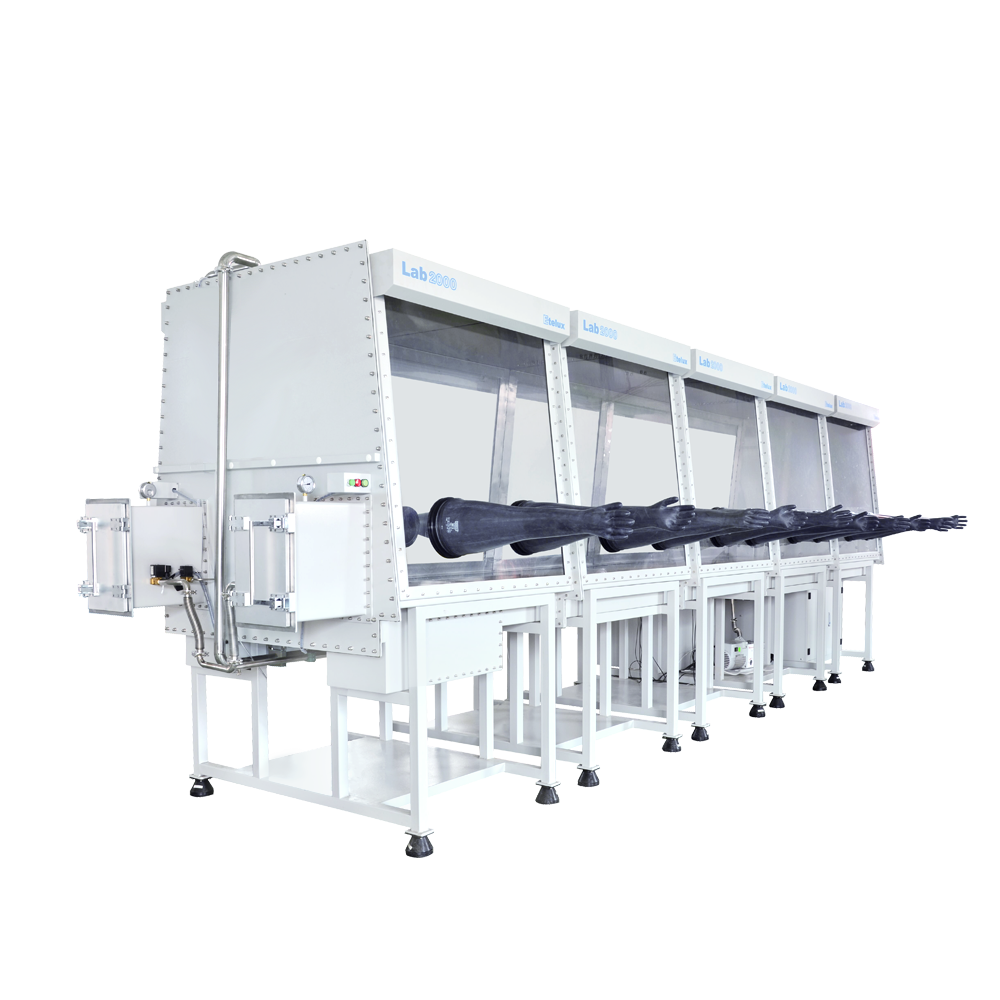
From Standalone Equipment to Full-Line Integration: Key Selection Considerations for Vacuum Glove Box & Coater Communication and Control Solutions
Vacuum glove boxes and vacuum coaters typically operate as standalone units for laboratory R&D, prototyping, and low-volume batch production. Manual independent control fully satisfies intermittent testing and small-scale sample fabrication requirements. However, for large-scale industrial thin-film manufacturing lines — including optical coating, semiconductor functional film deposition, and precision electronic coating systems — standalone equipment architecture […]